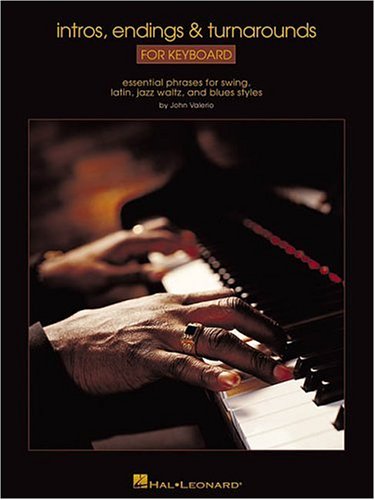
 Learn the intros, endings and turnarounds that all of the pros know and use! This new keyboard instruction book by John Valerio covers swing styles, ballads, Latin tunes, jazz waltzes, blues, major and minor keys, vamps and pedal tones, and more.
Customer Review: This book is fun ...
The book has well written, very musical phrases. The author suggests usage with several standards that should be in everyone's play book and it's fun to work them in with tunes you already know - in the proper keys. Take them apart, and there is something to learn in most of them. Great for browsing. The printing is good and the binding isn't troublesome on the rack. Nice experience. I would have rated it a five, but some of the pages have a tendency to work loose.
Customer Review: I love this book
I try to spend a half hour with it every night. This book will appeal to a wide range of interests. Whether you are a composer interested in theory, or a keyboardist enhancing your chops, there is something here for you. Most examples are four-measures long, but rich in musicality (kind of like what the Bach chorales are for those studying classical music.) The examples progress from simple chord progressions to more complex, and each is one is clearly explained. Nice melodies too! It is apparent that the author has spent a lot of time with each of the sub-genres (swing, ballads, blues, Latin, etc.) and has distilled his knowledge into a neat recipe book that will serve as a launching point for those wishing to further their expertise.
Many movies have been made about Nashville. Enough books about Music City have been written to fill a bookcase. And, of course, scores of songs are dedicated to the city of music. But, while music is the lifeblood of Nashville, visitors will also find here a city of culture and history, of haute cuisine, of pro sports, outstanding academics, natural beauty and pure Southern charm.
Nashville is a place where the past and the future peacefully coexist and build, one on the other, to create a destination that appeals to the interests of every visitor. This city is alive. You can feel its pulse when you walk down its sidewalks. And, fortunately, you can also hear it almost anywhere you go.
How Nashville became Music City:
From its very beginnings, Nashville grew from a foundation built on music. Music has always been the common thread connecting the life and soul of the city and its people. And visitors have always ventured here to experience the music that weaves such a fundamental pattern in its cultural, business and social fabric.
Nashville's earliest settlers celebrated in the late 1700s with fiddle tunes and buck dancing after safely disembarking on the shores of the Cumberland River, a spot now commemorated on First Avenue North with a replica of the original Fort Nashborough. Nashville's first "celebrity," the noted frontiersman and Congressman Davy Crockett was known far and wide for his colorful stories and fiddle playing.
As the 1800s unfolded, Nashville grew to become a national center for music publishing. The first around-the-world tour by a musical act was by the Fisk Jubilee Singers from Nashville's Fisk University. Their efforts helped fund the school's mission of educating freed slaves after the Civil War - and also put Nashville on the map as a global music center.
In 1897, a group of Confederate veterans chose Nashville as the site of a massive reunion. The event was held at the former tabernacle that would later become known as the Ryman Auditorium. So many former Confederate soldiers poured into town that a new balcony was built inside the tabernacle to accommodate their great numbers. It was dubbed "The Confederate Gallery," a designation still visible today as the Ryman continues to host an array of musical events.
Before even the Ryman became known as the downtown home of the Grand Ole Opry, it already enjoyed a national reputation. Enrico Caruso, John Phillip Sousa and the Vienna Orchestra gave roof-raising performances there that earned the Ryman the nickname "Carnegie Hall of the South." The Ryman's unrivaled acoustic qualities continue today - it has received Pollstar magazine's prestigious "Theater of the Year" award for two years in a row as the best auditorium in the nation to experience live music.
In 1925, the establishment of radio station WSM and its launch of the broadcast that would be called the Grand Ole Opry further secured Nashville's reputation as a musical center and sparked its durable nickname of Music City. The Opry, still staged live every week, is America's longest-running radio show, in continuous production for 80 years. It ignited the careers of hundreds of country stars and lit the fuse for Nashville to explode into a geographic center for touring and recording. The modern-day empire of Music Row, a collection of recording studios, record labels, entertainment offices and other music-associated businesses, populates the area around 16th and 17th Avenues South.
In recent years, cable television broadcast Music City's stars and music to the world. The Nashville Network, CMT and GAC took country music to a new level of acclaim and recognition. The gospel music series hosted by Nashville's Bobby Jones on Black Entertainment Television is now cable's longest-running program.
Nashville has also become a hub for pop, rock, bluegrass, jazz, classical, contemporary Christian, blues and soul music. Artists like Matchbox Twenty, India.Arie, Bon Jovi and Jewel, among many others, have come to Music City to write and record, and names like Michael McDonald and Donna Summer have chosen to call Nashville home.
The newly constructed Schermerhorn Symphony Center, home to the renowned, Grammy -winning Nashville Symphony, anchors the downtown end of the recently designated Music Mile, a symbolic stretch of roadway connecting the $120 million Symphony Center with the music district of Music Row, the vibrant new entertainment venues on Demonbruen Street, the Frist Center for the Visual Arts, the Country Music Hall of Fame, the Music City Walk of Fame and Museum and the Nashville Arena. The Music Mile perfectly illustrates how the music of Music City is indeed a common thread throughout the business, cultural and entertainment sectors of Nashville.
Nashville's connection to music is unequaled, and its reputation as Music City has been consistently proven for over 200 years. Welcome to the most musical city in the world. Music City-the only Music City!
Visit: http://www.NowPlayingNashville.com to see all Music City Events!
Check out all things MUSIC on the Nashville CVB website.
Contact Nashville Convention & Visitors Bureau:
150 4th Ave. N
Suite G-250
Nashville, TN 37219
800-657-6910
http://www.VisitMusicCity.com

No comments:
Post a Comment