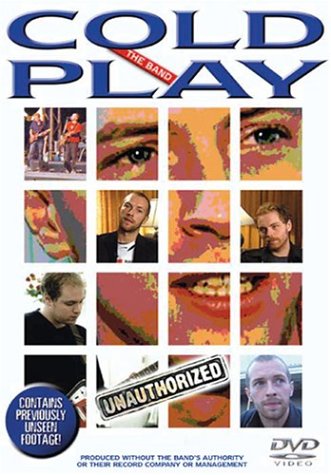
 The band first came together under the name Starfish at Camden Laurel tree, but the name Coldplay originated in a poem. From the very first it was obvious that in Chris Martin, a new and vibrant ?oice?had arrived and since their record signing in 1996
Customer Review: Passionate and Compassionate with Global Appeal
"It was musical love at first sight." ~Chris Martin talking about when he met Johnny Buckland Although this DVD doesn't contain any music by Coldplay, it is an insightful look at the band and how they made their way from playing in London pubs to playing on the stage of the world. Through short interviews with Chris Martin, you also get a sense of his higher mission and why there are more important things to worry about in the world, besides of course, buying ever album this band releases. His sense of humor and playful personality come across in his interviews and his admirable qualities include a sense of fairness. I was impressed by his idea to split the royalties equally amongst the band members. He not only promotes healing in the world, he is living his beliefs. He seems grateful for his life and you can see the fire of his soul radiating through his eyes. His soul is truly beautiful and I love the way he approaches life from a more poetic perspective. His lyrics have an emotive quality that do seem to be portraying his heart-felt concern for individuals and their struggles on the planet. As the story progresses various individuals in the music industry comment on how Coldplay developed their stage presence, how they had to deal with minor personality conflicts and then how their manager truly enabled their success through financial support. The main sections include: How it all Began First Gigs Let's Make a Record Get Signed Yellow Parachutes Breaking America A Rush of Blood to the Head The Future Bonus: Biography and Trivia Quiz - Questions about the bands original name and interesting facts about Chris Martin and how he was once a sign painter. The rise of any band to superstar status does seem to have common elements and if you are starting a band then this would be an excellent DVD to view for the chronological aspects alone, not to mention the realities of having to write hundreds of songs to find that one perfect song that connects with your audience. If you are a fan who is dying to know more about the members and their life stories, then this is an excellent introduction to the background and philosophy of Coldplay. The friendship factor is very evident in how Johnny Buckland and Chris play off each other intellectually, during the interviews. At times it seems like they are one mind as they engage in a humorous exchange. This DVD puts the bands rise to fame in perspective and is a great introduction to Coldplay's albums. The biography section is fairly short, however it gives enough information to get you interested in finding out more about each band member. ~The Rebecca Review
When should the male dancer begin to lead his partner into her six-count or eight-count footwork once the swing music begins? The answer is that he should begin leading her on any of the song's downbeats; that is, on the "1" count, the "3" count, the "5" count or the "7" count. These "base beats" are the backbone or pulse of a song! You don't need to be a trained musician to understand a song's tempo (or timing), just listen to music and pick out the rhythm section (drums, bass, guitar or piano).
To take the pulse of the song and determine its number of beats per minute (bpm), count these downbeats for fifteen seconds and then multiply by four. Very slow swing songs have around 70 bpm and very fast ones have upwards of 200 bpm. The swing songs that I personally enjoy dancing to the most, average about 125 bpm which coincidently approximates my optimum cardio-training heart rate when I exercise. Notice that these downbeats differ from the upbeats that occur on the "2" count, the "4" count, the "6" count or the "8" count. In St. Louis Imperial Swing, we begin stepping immediately on any of the music's downbeats; however, this is not true of all styles of dance. In the Cha-Cha, for instance, dancers begin stepping after any of the music's upbeats.
Beats per minute became common terminology in popular music during the disco era because of its usefulness to DJs; and it remains important in dance music today because both our style of dance and our footwork rhythms are determined by the tempo of the music! The original or classic style of Imperial Swing, which is danced "in the round," is performed to music with a faster tempo (130-185 bpm) using primarily the slower single step and double step footwork rhythms. Today's contemporary style of Imperial Swing, which is danced within a slot, is a combination of both East Coast Swing (135-175 bpm) and West Coast Swing (75-115 bpm). Dancers perform this popular, "slot-bop" hybrid to music with a slower tempo (100-135 bpm), and they use primarily the faster, triple step footwork rhythms. Remember, the terms are music timing (or tempo) and footwork rhythms (or steps) but not vice versa!
The "time signatures" of different music styles tell dancers how many beats there are to a measure, and which note represents that beat. Swing music uses 4/4 timing; that is, there are 4 beats to a measure (4/4) and the quarter note gets the beat (4/4). For example, on the 1 and 2 count of your six-count, triple step footwork, the "1" is an eighth note (or a half-beat) and the "and of 1" is an eighth note (or a half-beat). Together they add up to a quarter note or 1 beat; and the "2" count is a quarter note or 1 beat. On the 3 and 4 count, the "3" is an eighth note (or a half-beat), and the "and of 3" is an eighth note (or a half-beat). Together they add up to a quarter note or 1 beat; and the "4" count is a quarter note or 1 beat. These 2 beats bring the cumulative total up to 4 beats or one measure.
Finally, on the 5 - 6 breakstep, the "5" count is a quarter note (or 1 beat) and the "6" count is a quarter note (or 1 beat). These final two 2 counts bring the total up to six beats or one and a half measures. To summarize this footwork count, dancers take eight steps in six beats of the music. Good dancers let the music tell them what to do with their feet. If they begin their footwork on any of the song's downbeats, and then end it on the sixth (or eighth) beat, then they are dancing in time with the music and finishing their steps when they are supposed to. As Skippy Blair, the renowned swing dance teacher, author and recipient of the California Swing Dance Hall of Fame Award, tells her students: "please don't tell me how long to hold the beat; just tell me what the count is, so I can place my feet!
Copyright 2008 Skip Culver, Certified Swing Instructor. Member of the West County Swing Dance Club and author of the manual: Imperial Swing Dancing (visit: http://www.ImperialSwing.com)
Henry H. "Skip" Culver, Jr. is a member of the West County Swing Dance Club in St. Louis Missouri. He is a Gold Seal Instrument Flight Instructor and the author of the bestselling book on navigation titled: IFR 'Pocket Simulator' Procedures. In 2000 Skip turned his attention from aviation towards the dance floor. He became a Certified Swing Dance Instructor in 2004, and then with over seven years of detailed notes from various classes and workshops in hand, he began assembling the Imperial Swing Dancing manual which he published in June of 2007. Skip is a frequent contributor of articles on swing dancing to different club newsletters throughout the United States.
latin cds
No comments:
Post a Comment