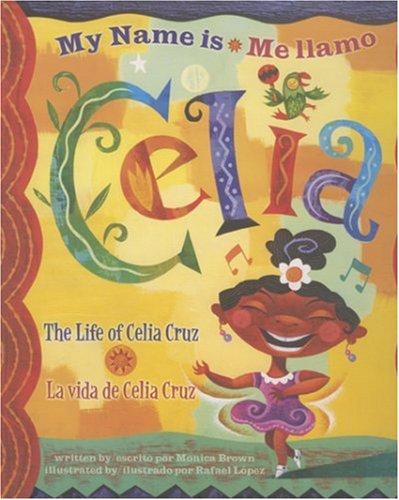
 This bilingual book allows young readers to enter Celia Cruz's life as she becomes a well-known singer in her homeland of Cuba, then moves to New York City and Miami where she and others create a new type of music called salsa.
Customer Review: Queen of Salsa
Celia Cruz is brought to life for young children in this colorful book. Like the tropics from which she came, the book is full of vibrant illustrations. The story is put into simple terms for young readers or a teacher or parent to read. Since the illustrations are so vibrant and bold children will be enthralled by the unique features of the art work. Each biographical page is bilingual for reading in Spanish or English or both. The book describes her early family life in Cuba, her departure after the revolution, her musical group Sonora Mantacera, meeting her musician husband,her associations with other salsa greats like Tito Puente and Willie Colon, her relocation to Miami and the various honors and recognitions she achieved. This is a great little book for primary and middle school libraries as well as community libraries. Students whoose first language is Spanish can benefit from the bilingual book through middle school years. This is a fun book.
Customer Review: Wonderful!
My Name is Celia: The Life of Celia Cruz is written by Monica Brown and illustrated by Rafael Lopez. The book is the recipient of a Pura Belpre' Illustrator Honor Award for outstanding work that portrays, affirms and celebrates the Latino cultural experience in an outstanding work of literature for children and youth. The exciting and inspirational life of beloved Cuban-born salsa queen, Celia Cruz, is celebrated in the bilingual book My Name is Celia Me Llamo Celia: The Life of Celia Cruz. Celia was born in Havana to a large family where their lives were intertwined and music was an important part of everyday life. Celia's papa wanted her to become a teacher but music filled her soul with happiness. She was encouraged by a teacher to "go out into the world and sing...." Celia experienced prejudice and fled her beloved country Cuba when the revolution began. From Cuba, Celia traveled the world sharing her love of music with the world. Rafael Lopez' illustrations are vibrant, fluid combinations of color that beg to be studied. The scenes fill the page and stir emotions as you read the story and live it through his drawings. Armchair Interviews says: My Name is Celia: The Life of Celia Cruz is a beautiful and educational addition to any child's library. We highly recommend it.
Problems with humidity can lead to heartbreak for the classical (or other) guitarist. Excessive humidity or dryness can ruin an instrument probably quicker than you think.
You must always be aware of what conditions you are leaving your instrument, whether inside a guitar case or within a room or in the open. They should NEVER be left in the sun for any length of time.
When guitars are built they are usually in an environment where the relative humidity of the room is kept constant, roughly around 50%.
To be safe you ideally should keep your instrument around this mark though they are generally regarded as safe between 40%-70% as the upper and lower margins. Below or above this can be drastic for your instrument!
An interesting example of anecdotal evidence of problems with humidity I've heard is with Ramirez guitars.
Because they're made in Spain where the humidity is often above the 50% mark and are shipped to areas where the humidity is much lower with dry winter conditions, they can easily develop cracks and slits throughout the guitar.
Having made an investment for such a beautiful guitar youd be mad not to invest in a relatively cheap system for keeping the humidity of your guitar constant, like a guitar humidifier case for example.
The damage caused by too much humidity or of drying out your instrument can range from cracks, splits and shrinkage to warping and even snapping of the wood.
There are many things you can do to prevent problems from the start. You know the old saying "an ounce of prevention is worth a pound of cure."
I would recommend keeping your house, or wherever you keep your instrument, at a constant temperature and humidity all year round.
Next I would get a humidifier for my guitar case, whether one sold commercially which releases moisture slowly and attaches to the inside of your case, or a home-made one which could consist of a wet cloth (be careful not to let it touch your instrument as it may damage the wood).
Another thing to invest in is a "hygrometer", which is an instrument that will keep track of humidity, or lack of it in your guitar case. As mentioned above, some guitar cases are made with these things as standard.
If you follow these few simple rules and keep an eye out for changes in temperature and humidity conditions it shouldn't be hard to keep your instrument in good order.
Trevor Maurice is an Australian, living in beautiful seaside Maroubra, in the eastern suburbs of Sydney.
He's been involved in playing guitar (mainly classical) for longer than he cares to remember and has also taught the instrument for many years. He is teacher trained, having a Diploma of Education (Majoring in music)
He has also taught Primary (Elementary) school for many years and had a long-held dream to build a quality website for the classical guitar that is of use to anyone even slightly interested in this beautiful instrument. He has now made that dream a reality with the highly rated...
http://www.learnclassicalguitar.com/index.html
latin music lyrics
No comments:
Post a Comment